Soft, stained, or bubbling drywall removed back to sound material and replaced.
Here is the thing about water-damaged drywall that people find hard to accept: it does not recover. Not with time, not with a fan, not with a dehumidifier, and definitely not with a coat of stain-blocking primer.
Drywall is a gypsum core sandwiched between paper. The gypsum's structure depends on a crystalline bond that water breaks. Once it has been saturated, the core has crumbled at a level you cannot see and the paper facing has released from it. Dry it out and you have dry crumbled gypsum with loose paper on it. It is lighter, it is softer, and it is finished as a building material.
We are direct about this because the alternative is watching someone spend money twice.
Water-damaged drywall does not recover. Not with time, not with a fan, and not with a coat of primer.
Not everything that looks like water damage needs the drywall replaced. The distinction is worth understanding before anyone quotes you.
If the leak is fixed and the board is still firm — press it with your thumb and it does not give, the paper is still bonded, there is no sag — you may have a paint problem rather than a drywall problem. Stain-blocking primer and paint can be the right answer. We will tell you when that is the case, and no, we do not make money on it. We would rather you trust what we say the next time.
Give under thumb pressure means the core is gone. Sag means it is gone and gravity is winning. Paper lifting or bubbling means delamination. Any of these and the material is coming out — there is no version of this where it gets saved.
If you can rub the cut edge and it powders, that is a core that has lost its bond completely. This gets cut back well past the visible boundary, because the damage always travels further than the stain shows.
Worth being straight with you: we are drywall repair, not a mold remediation company. Small amounts of surface growth on drywall that is coming out anyway leave with the drywall. But if you have significant growth, or growth in the cavity behind the board, that is a remediation job and it needs to happen before we put anything back. We will tell you if we think that is what you are looking at rather than quietly covering it up.
We probe outward from the visible damage until we hit board that is firm all the way through, and we cut there. On a ceiling this often means going noticeably past the stain, because water traveled through the core further than it stained the paper.
With the board off, the cavity is visible. We check whether insulation is wet — wet insulation has to come out, it will not dry in place inside a wall — and whether the framing is sound. If we find something that is not ours to fix, we tell you before we close it up, not after.
If the cavity is damp, it dries before anything goes back. Closing a wet cavity with new drywall is how you get a mold problem that surfaces in six months.
Then it is standard sheetrock replacement: hang, tape, float in coats, and match the texture to the surrounding surface.
You can tell a lot from the stain itself, and it makes the phone call much more useful.
A stain with a crisp, defined outer ring is generally a dead event — water came, spread to its limit, and dried. A soft or feathered edge, or one that looks like it is still darkening, suggests something ongoing.
Multiple rings, like tree rings, mean it wet and dried and wet again. That is a live or intermittent source, usually seasonal, and it needs finding before anyone repairs anything.
If it is dipping, the core is gone. No amount of drying brings that back.
Press it. Firm, with the paper still bonded, means possibly sound. Any give at all means the gypsum core has lost its crystalline bond and the board is coming out.
The drywall is half the question. The cavity is the other half, and opening the wall is the only chance anyone gets to look.
Wet insulation does not dry in place. There is no airflow in a wall cavity. It stays damp, loses most of its R-value, and becomes exactly what mold wants. If it is wet, it comes out.
The framing usually survives. Wood tolerates far more water than gypsum does. But if it has not survived, you need to know before it gets closed up.
The cavity dries before anything goes back. Closing a damp cavity with new board buys you a mold problem in six months.
We are drywall repair, not restoration, and the boundary is worth stating.
We do not do plumbing or roofing — if your source is live, that trade comes first, and we will not hang board until it does. We do not do mold remediation; small surface growth on board that is leaving anyway leaves with it, but significant growth or growth in the cavity is a remediation job that happens before we start. We do not paint.
Each of those answers costs us a job sometimes. We would rather give them than sell you a repair we know will fail.
The most common objection we get, so here is the reasoning.
Water travels through the gypsum core faster and further than it stains the paper facing. The stain you see is where enough water sat long enough to discolor the surface — but the core is compromised out past that boundary, in board that still looks perfectly fine from the room.
Patch to the edge of the stain and your new patch is bonded to material that has already lost its structural bond. It will crack at that boundary, usually within the year, and the crack will trace the outline of the repair.
So we probe outward until we hit board that is firm all the way through, and we cut there. On a ceiling that is often noticeably past the stain. It looks like overkill. It is the difference between a repair and a rerun.
Water jobs take longer than their size suggests, and it is worth knowing why.
If the cavity is damp, it dries before anything goes back — closing a wet cavity with new board is how you buy a mold problem that surfaces in six months. That wait is not negotiable and it is not us being slow.
Then the compound itself needs to dry through every coat. Recoating wet compound gives you shrinkage cracks later, and humidity extends every one of those waits.
We will tell you the realistic timeline for your specific job rather than the optimistic one.
Water damage is the one service where insurance comes up regularly, so to be clear about what we are and are not.
We are not a restoration contractor. We do not bill carriers directly, we do not do emergency dry-out, and we do not handle remediation.
What we do give you is a clear written scope and price for the drywall repair itself, itemized enough that you can hand it to an adjuster. Most people find that is what they actually needed — the drywall is one line in a claim someone else is coordinating.
If your loss is large enough to need a restoration company, use one. We are the right call for the repair after the dry-out, not instead of it.
This is one of the most common calls on homes we repair in Farmers Branch. Second-floor bathrooms over first-floor living space are the single most common source we see. The stain shows up on a downstairs ceiling and the cause is a shower pan, a wax ring, or a supply line above it.
It comes up regularly with Allen drywall repair. We also see a steady volume of attic-sourced damage — air handler condensate lines that back up in summer and drip into the ceiling below. In a North Texas August that unit runs constantly, and a clogged condensate line finds your ceiling fast.
Much of the work we do in The Colony looks exactly like this. And roof-sourced damage after storm season, which tends to arrive in clusters after a bad hail event.
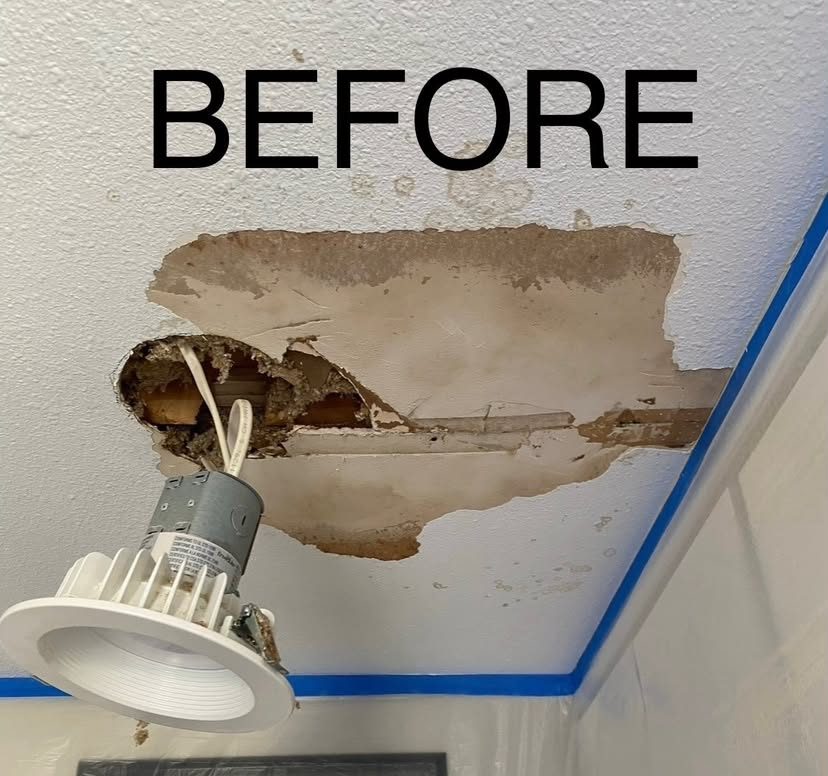
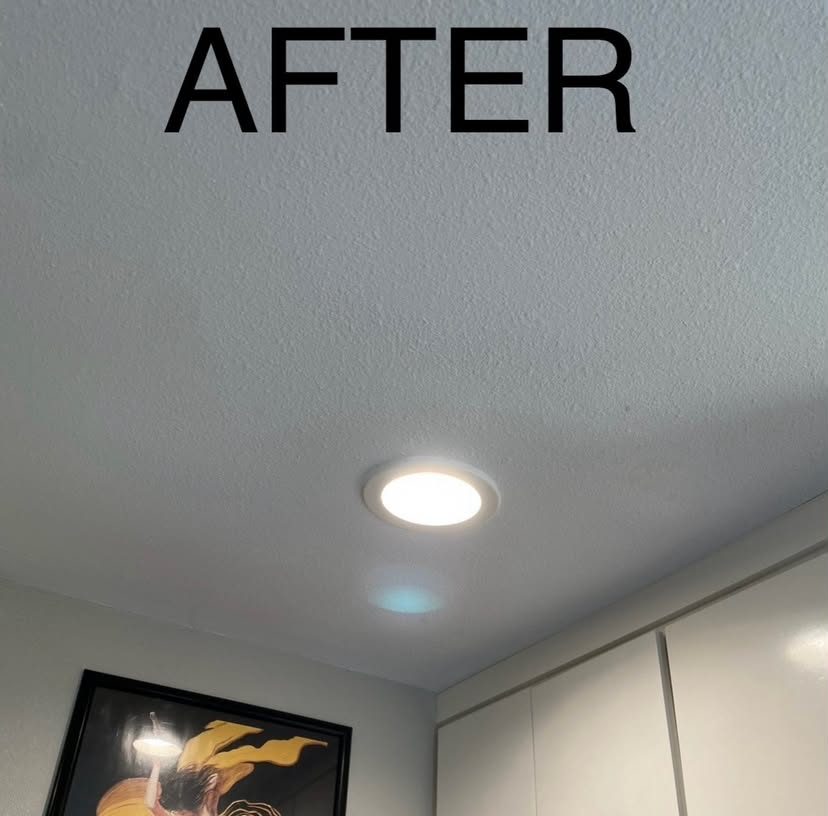
Water damage around a recessed light. Finishing cleanly up to a fixture is its own problem — there is no room to feather the compound out in one direction, so the float has to be worked wider on the sides that are open.
Tell us what happened and roughly how big the area is. A photo texted over usually settles the scope in a minute.
You get the scope and the number before we start. Patch versus sheet replacement, texture type, and how many coats it needs.
We cut, hang, tape, float, and match texture, then clean the space. Most single-room repairs are done inside one visit.
Water Damage Drywall Repair across the North Dallas metro.
Our pricing starts at $300 for any job, however small. Beyond that it depends on the size of the damage, the texture that has to be matched, and how many coats the finish needs. Text a photo to (972) 469-5046 for a free virtual estimate and we will give you a real number, not a placeholder range.
Virtual estimates are free — text or email a photo and we will come back with a real number, no charge and no obligation. In-person estimates are $100, credited back against your job when you book with us. For most repairs a clear photo is all we need.
Most single-room repairs are handled in one visit. Larger areas, or repairs that need multiple mud coats to dry properly, can run into a second day. We tell you which one you are looking at up front.
Yes. Matching the surrounding texture is part of the repair, not an add-on. A flat patch with the wrong texture still reads as a repair.
Yes. The North Dallas metro is inside our service area. Call (972) 469-5046 to get on the schedule.
If the board is genuinely sound — firm under pressure, no sag, paper still bonded — then a stain-blocking primer can be the right call, and we will say so. But if the board went soft at any point, drying it does not bring it back. The gypsum core has already crumbled. Painting it just hides the problem until it telegraphs through.
The simplest test is time. A stain that has not grown in a year is a dead source. A stain that got bigger after the last rain, or that reappears after you run a particular fixture, is live. If you are not sure, tell us the history on the phone and we can usually work it out from the pattern.
No. We repair drywall. Small surface growth on board that is being removed anyway leaves with the board, but significant growth or growth in the wall cavity is a remediation job and it has to happen before new drywall goes in. We will tell you plainly if that is what we are looking at.
We do the drywall repair and give you a clear written scope and price you can hand to your adjuster. We are not a restoration contractor and we do not bill carriers directly.
The compound needs to be fully dry through every coat, and texture needs to set. We will tell you the timeline for your specific job when we finish — it depends on how many coats the repair needed and what the humidity is doing.
Call and describe the damage. We will tell you what it needs before anyone drives out.
Call (972) 469-5046Every city below has its own water damage drywall repair page with local detail, pricing questions answered, and the fastest way to reach us.
Water Damage Drywall Repair calls come in from across our tight North Dallas service area — Plano, Frisco, McKinney, Allen, Richardson, Carrollton, Addison, Coppell, Farmers Branch, and The Colony. One crew, one standard, close to home.